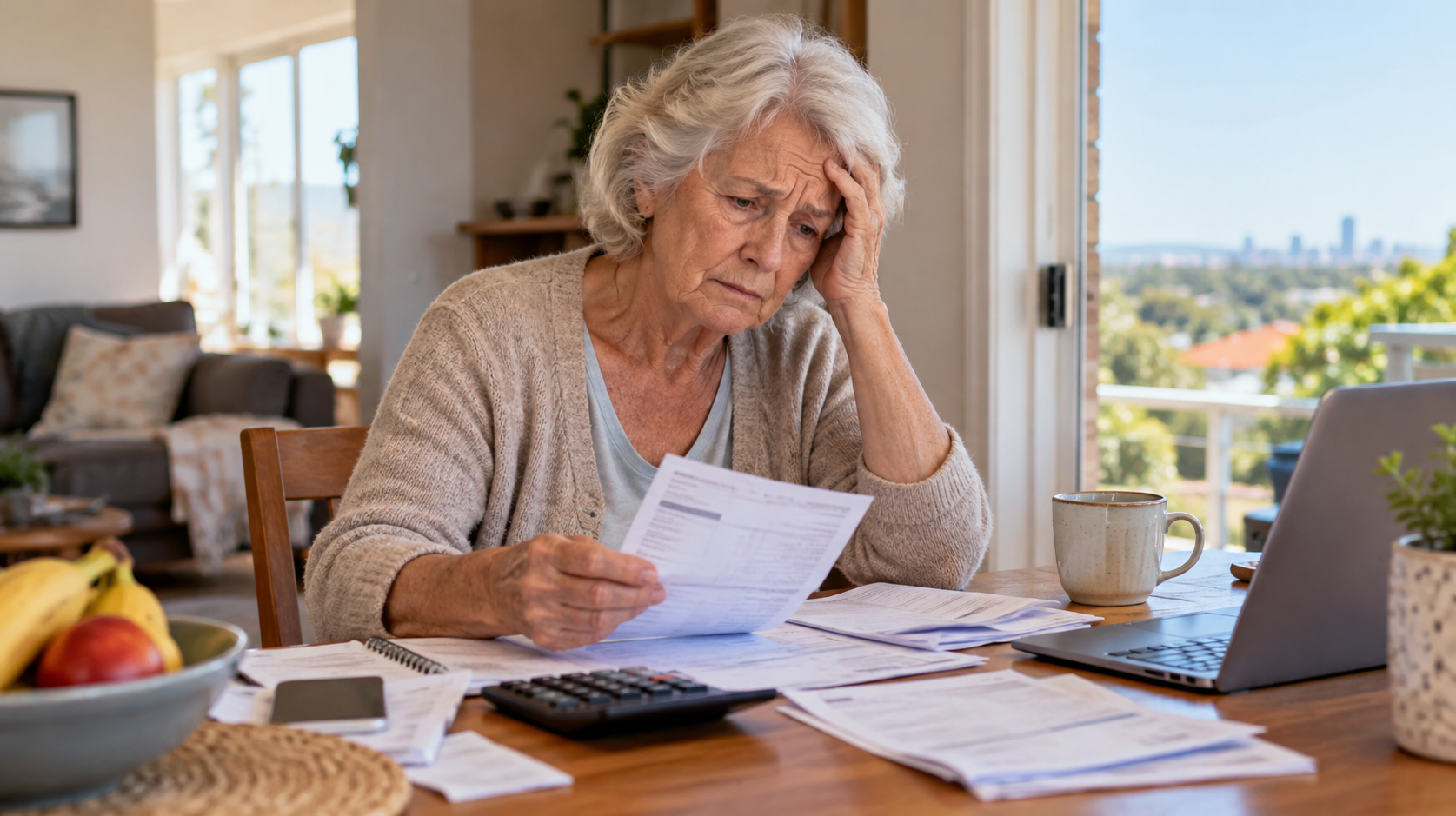
Australians living alone are facing a growing financial burden as rising rents, electricity bills and everyday expenses make it increasingly difficult to manage a household on one income. New attention on the so-called singles tax has highlighted estimates that solo Australians can face thousands of dollars in additional annual living costs compared with people who share expenses with a partner.
The pressure is particularly serious for older Australians receiving Centrelink payments, including Age Pension recipients who must cover rent, groceries and utilities without another household income. With housing costs rising 5.7 per cent over the year in the inflation figures cited, and more Australians expected to live alone in the coming decades, the financial disadvantages of single-person households are becoming harder to ignore.
What Is the Singles Tax in Australia?
The singles tax is an informal term used to describe the additional financial burden faced by people who live alone or rely on a single income.
It is not an official tax collected by the Australian Taxation Office.
Instead, it refers to the higher per-person cost of paying for housing, electricity, internet, groceries and other household essentials without someone else sharing the bills.
For example, a couple renting a property for $600 a week may each contribute $300 if they split the cost equally.
A single person renting the same property must cover the entire $600.
The same problem applies to many household expenses.
Internet connections, council rates, home insurance and basic electricity supply charges do not necessarily become half as expensive simply because only one person lives in the property.
That means single Australians can spend a larger proportion of their income maintaining an ordinary household.
The financial difference becomes particularly noticeable when rent increases or an unexpected expense occurs.
Couples may have another income to help absorb the additional cost, while someone living alone has fewer options.
Why Are Single Australians Paying Thousands More?
The financial disadvantage of living alone comes largely from the inability to share fixed household expenses.
Analysis of Australian Bureau of Statistics figures has highlighted a substantial difference between the average spending of single-person households and couples.
The reported figures show that a one-person household spends approximately $2,835 per month on living expenses.
A couple spends about $4,118 per month combined, equivalent to $2,059 per person.
That produces a difference of approximately $776 per person each month.
Over a full year, the difference would amount to around $9,312.
However, this comparison does not mean every single Australian pays that amount as an additional cost.
Household spending varies depending on income, age, housing circumstances and consumption habits.
The widely discussed $7,800 annual singles tax is another estimate intended to illustrate the additional financial pressure of maintaining a household without a partner.
Neither figure represents a government charge or a fixed amount that applies to everyone.
What the comparisons demonstrate is that sharing a home can significantly reduce the cost of living per person.
Housing Costs Are Adding to the Pressure
Housing has become one of the biggest financial challenges for Australians living alone.
The Australian Bureau of Statistics figures cited in the report showed housing costs increasing by 5.7 per cent over the year.
Housing was also identified as the largest contributor to inflation in that release.
The housing component of the Consumer Price Index includes expenses such as rent, electricity, water and certain costs associated with building or maintaining homes.
It does not directly include mortgage interest repayments.
For renters, rising weekly payments can quickly consume a larger share of their income.
A rent increase of $50 per week adds $2,600 to annual household expenses.
For someone living alone, that additional amount must come entirely from their own budget.
Couples may be able to divide the increase between two incomes.
Single renters often have to reduce spending on groceries, transport or other necessities to make up the difference.
The situation can be even more difficult for people receiving fixed government payments.
Their income may increase through indexation, but that does not guarantee it will keep pace with rent increases in their local area.
Brisbane Pensioner Fears Another Rent Increase
The difficulties facing single renters are reflected in the experience of 70-year-old Brisbane resident Louise Taylor.
Louise receives the Age Pension through Centrelink and has struggled to find suitable rental accommodation.
She previously experienced repeated rejections while applying for rental properties.
Eventually, she accepted a small duplex because she felt she had few alternatives.
The property was not ideal for her needs, but securing somewhere to live became more important than finding a comfortable home.
Louise believes applying for accommodation as part of a couple may have improved her chances.
With two people potentially contributing to the rent, landlords may view a household as having greater financial capacity.
However, rental application outcomes depend on several factors, and being single does not automatically mean an applicant will be rejected.
Louise is now on a housing waiting list and has contacted organisations that provide housing assistance.
Her biggest concern is what could happen if her rent increases again.
She worries that another rise could force her to leave her home.
Possible alternatives include moving into shared accommodation or living with her daughter.
For an older person who values independence, either option could involve significant personal changes.
Her experience highlights how quickly housing insecurity can develop when a pensioner must manage rent alone.
Why Older Women Are Particularly Vulnerable
Women aged 65 and over represent a particularly important group in discussions about single-person households.
Older women are among the Australians most likely to live alone.
Some have experienced the death of a partner, divorce or separation.
Others have remained single for much of their adult lives.
Their financial circumstances can vary considerably.
However, women who spent years outside paid employment while caring for children or family members may have accumulated less superannuation.
That can make them more dependent on the Age Pension during retirement.
Renting creates another challenge.
An older homeowner may still face rising maintenance, insurance and utility costs, but a renter must also meet ongoing rental payments.
When rent consumes a large portion of pension income, there may be little money left for unexpected expenses.
Medical appointments, car repairs and household emergencies can become difficult to manage.
This is one reason housing affordability is especially important for older Australians living alone.
Homeowner Em Farr Also Feels the Singles Tax
The financial pressure of living alone is not limited to renters.
Em Farr, 59, has described how her household budget became more difficult after her son moved out.
Em receives a Centrelink disability-related payment and owns her home.
Although she does not face the same rental uncertainty as Louise Taylor, she still has regular household expenses.
Her son previously contributed board payments, which helped cover some of those costs.
After he left, Em had to manage the bills without that additional contribution.
She reported cutting back on spending as groceries, petrol, meat, fruit and vegetables became more expensive.
Her situation shows that even homeowners can experience financial stress when a household changes from two contributors to one.
Em has considered renting a spare bedroom to a local student to increase her income.
However, she is concerned about how receiving board or rental payments might affect her Centrelink entitlements.
That concern is understandable because income from renting part of a home can affect some means-tested payments.
The treatment depends on the payment, the arrangement and the relevant Centrelink rules.
Anyone considering renting out a room should check how the income would be assessed before entering an agreement.
Single Renters Face Financial and Mental Pressure
For younger Australians, the singles tax can affect both housing choices and everyday independence.
Melbourne resident Brittany Salkeld, who is in her late 30s, has described the difficulty of finding suitable accommodation on one income.
She said the financial disadvantage became particularly noticeable when she needed to move.
Competing for rental properties can be challenging when applicants must demonstrate that they can comfortably afford the weekly rent.
Someone applying alone may have less combined income than a couple applying for the same property.
Brisbane renter Kate Fancourt, 32, has also described the pressures of managing housing costs after a relationship breakdown.
She previously owned a property with a partner and found the shared financial arrangement easier to manage.
Living alone has meant taking responsibility for every expense.
Kate also highlighted the mental workload involved.
Negotiating rental matters, arranging repairs, managing bills and planning finances all become individual responsibilities.
When income changes unexpectedly, there may be no second earner to help cover the shortfall.
The result is not simply a more expensive lifestyle.
For some people, it can mean reduced financial security and greater stress.
More Australians Are Choosing or Experiencing Solo Living
Single-person households have become increasingly common across Australia.
According to the historical figures cited, the proportion of households containing one person increased from 18 per cent in 1981 to 23.9 per cent around two decades ago.
That proportion has since risen to approximately 27.5 per cent.
The trend reflects several social and demographic changes.
Australians are living longer, relationships are changing and some people are choosing to remain single.
Others live alone following divorce, separation or the death of a partner.
Greater independence and changing expectations around marriage have also influenced household patterns.
The Australian Bureau of Statistics has projected that between 3.4 million and four million Australians could be living alone by 2046.
That would represent substantial growth compared with 2021.
As the number of single-person households increases, the affordability of smaller homes and rental properties is likely to become an even more important issue.
Housing policies designed mainly around couples and families may not fully reflect the needs of people living independently.
How Centrelink Payments Affect Single Pensioners
Centrelink payments can provide essential financial support to Australians who are retired, living with disability or experiencing other circumstances that affect their income.
However, payment eligibility and rates vary depending on individual circumstances.
Single Age Pension recipients generally have a higher maximum payment rate per person than each member of a couple.
This reflects, in part, the additional costs associated with maintaining a household alone.
But receiving a higher individual rate does not necessarily eliminate the financial disadvantage.
Rent, utilities and other fixed expenses can still absorb a substantial share of a single pensioner’s income.
Some eligible renters may also qualify for Commonwealth Rent Assistance.
The amount depends on factors including rent paid, household circumstances and the type of payment received.
Rent Assistance is subject to eligibility rules and maximum payment limits.
It does not automatically cover the full cost of a rent increase.
For pensioners facing housing insecurity, community housing providers and state housing assistance programs may offer additional options.
However, access to affordable housing can be limited, and waiting times may be lengthy.
Can Renting Out a Room Affect Centrelink Payments?
Australians receiving Centrelink payments sometimes consider renting out a spare bedroom to help manage living expenses.
For homeowners, this can provide extra money without requiring them to sell their property.
However, the arrangement may affect income-tested payments.
Centrelink can assess rental income differently depending on whether the arrangement involves a boarder, lodger or tenant.
The treatment may also depend on whether meals or other services are provided.
Some arrangements can have implications for the assets test or the principal home exemption.
There may also be tax consequences.
For these reasons, pension recipients should not assume that every dollar received from a boarder will be treated the same way.
Before renting out a room, it is sensible to confirm the applicable rules with Services Australia and obtain appropriate tax advice if necessary.
That can help avoid unexpected payment reductions or reporting problems.
What Can Single Australians Do to Reduce Living Costs?
There is no simple way to remove the financial disadvantage of living alone.
However, reviewing household expenses can sometimes reduce the pressure.
Electricity and gas plans are worth comparing because usage rates and supply charges can vary between providers.
Insurance, mobile phone and internet plans may also offer opportunities for savings.
Single renters may benefit from checking whether they qualify for state or territory concessions, rental assistance or other support programs.
Eligible pensioners may be entitled to discounts on utilities, transport or council rates, depending on where they live.
People considering shared accommodation should weigh the potential financial savings against privacy, safety and lifestyle needs.
For some older Australians, living with another person may reduce expenses considerably.
For others, remaining independent is an important priority.
Any decision should reflect personal circumstances rather than financial considerations alone.
Why the Singles Tax Is Becoming a Bigger Australian Issue
The singles tax is becoming more significant as Australia experiences rising housing costs and an increasing number of people living alone.
Although the term does not describe an official tax, it captures a genuine financial difference between maintaining a household independently and sharing expenses.
The reported $7,800 annual estimate has attracted attention because it puts a figure on a problem many single Australians already experience.
For pensioners such as Louise Taylor, the issue is not about paying extra for convenience or lifestyle choices.
It is about finding secure accommodation while living on a limited income.
For homeowners such as Em Farr, losing a household contribution can make previously manageable expenses difficult to afford.
Younger renters face similar pressures when trying to secure housing or recover financially after a relationship ends.
With millions more Australians projected to live alone in the coming decades, affordable housing and adequate income support will remain important issues.
The challenge is particularly urgent for older renters who have limited opportunities to increase their earnings.
As household costs continue to rise, living alone is becoming an increasingly expensive reality for Australians across different age groups and income levels.