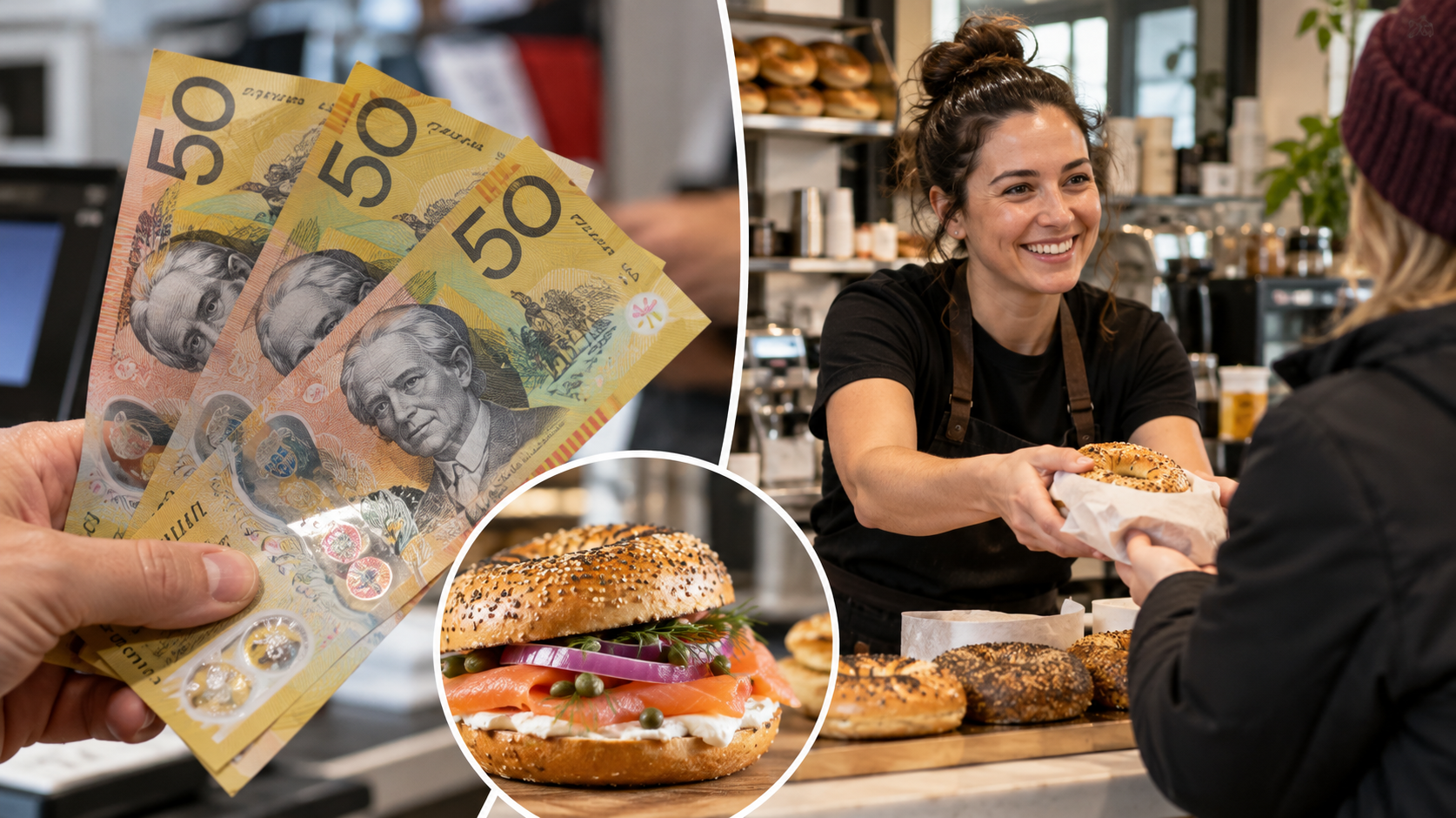
A Sydney bagel shop owner has responded to a counterfeit cash incident with an unexpected act of kindness, offering free meals to Australians struggling with the rising cost of living. Lox In A Box, a hospitality business operating four venues across Sydney, recently discovered that customers had handed over three counterfeit $50 notes, leaving the business $150 out of pocket.
Instead of simply expressing frustration, business owner Candy Berger used the incident to highlight the financial pressure facing both customers and small businesses. She urged people experiencing genuine hardship to ask for help rather than resorting to fake money. Her response comes as counterfeit Australian banknotes continue causing losses for businesses and private sellers, with police warning people to check cash carefully before accepting payments.
Sydney Bagel Shop Loses $150 After Receiving Fake $50 Notes
Lox In A Box became the latest Australian business to experience a counterfeit cash incident after receiving three fake $50 banknotes within a single week.
The notes initially went unnoticed during normal customer transactions.
It was only when Candy Berger took the money to the bank for depositing that she discovered something was wrong.
Bank staff informed her that the three notes were counterfeit, meaning the business had effectively lost $150.
For a large company, that amount might seem relatively small. However, independent hospitality businesses often operate with tight profit margins and substantial running costs.
Rent, electricity, ingredients, insurance, and staff wages can consume much of their revenue.
Losing $150 through fraudulent payments means the business has provided food and service without receiving legitimate payment.
Berger explained that smaller businesses do not have unlimited financial resources to absorb such losses.
Her comments reflected the difficulties facing many hospitality operators who are trying to remain profitable while customers reduce discretionary spending.
However, what attracted attention was not simply the financial loss.
It was the compassionate way Berger responded to the possibility that someone might have used counterfeit cash because they could not afford a meal.
Business Owner Offers Free Bagels to People Who Cannot Afford Food
Following the discovery, Berger shared a message on Instagram addressing the counterfeit notes and the broader financial difficulties facing Australians.
She acknowledged that rising living expenses and financial uncertainty have placed considerable pressure on households.
Rather than directing anger toward people experiencing genuine hardship, she encouraged anyone unable to afford food to approach her business directly.
Her message was simple: “If you need a bagel, just ask.”
Berger explained that she would prefer to provide someone with a free meal rather than have them feel compelled to use counterfeit money.
She made it clear that her offer was genuine and intended for people who were struggling financially.
At the same time, she stressed that using fake banknotes was not an acceptable solution.
Counterfeit cash creates additional financial pressure for businesses that are already managing increasing costs.
Her response highlighted a difficult situation in which both customers and hospitality operators may be experiencing financial stress.
By offering assistance, Berger attempted to separate genuine financial hardship from dishonest payment practices.
The gesture also demonstrated how some small businesses are trying to maintain a sense of community despite challenging economic conditions.
Cost of Living Pressures Continue Affecting Australian Families
The incident comes against a backdrop of ongoing financial pressure for Australian households.
Housing expenses, grocery bills, insurance premiums, and utility costs remain significant concerns for many families.
Even when inflation slows, prices do not automatically return to earlier levels.
For households already spending most of their income on essential expenses, small increases can make everyday purchases more difficult.
Eating out or buying takeaway food is often one of the first expenses people reduce when their budgets become stretched.
Hospitality businesses feel the effects of those decisions.
Lower customer spending can reduce revenue at the same time that operators face their own rising costs.
Berger’s comments reflected this shared financial pressure.
Customers may be struggling to afford meals, while business owners are working to cover wages, rent, and operating expenses.
However, financial hardship does not make counterfeit payments legal or harmless.
When a business accepts fake cash, it cannot recover the value simply by depositing the notes at a bank.
The loss falls on the person or business that accepted the counterfeit currency.
Berger’s offer therefore provided a practical alternative for people genuinely needing assistance without transferring the financial burden through fraudulent transactions.
Counterfeit Australian Banknotes Raise Concerns for Businesses
Counterfeit currency incidents have prompted warnings from police authorities across Australia.
Businesses handling cash are particularly vulnerable because employees often need to complete transactions quickly.
Restaurants, convenience stores, takeaway outlets, and retail businesses may receive dozens or hundreds of cash payments during busy periods.
Under those conditions, a counterfeit note can pass through without attracting immediate attention.
The Reserve Bank of Australia explains that counterfeit notes can circulate through face-to-face transactions, particularly when recipients do not closely inspect the money.
Fraudsters may also attempt to use counterfeit notes for relatively inexpensive purchases.
For example, someone presenting a fake $100 note for a small purchase could receive genuine Australian currency as change.
That creates a financial loss greater than the value of the goods provided.
Although Australia has sophisticated polymer banknotes with several security features, counterfeit attempts still occur.
The presence of security features makes counterfeiting more difficult, but it does not eliminate the need for basic checks.
Small businesses are encouraged to ensure staff understand the appearance and feel of genuine Australian currency.
Gold Coast Man Loses $900 in Fake Cash During iPhone Sale
Counterfeit cash is not limited to restaurants and retail businesses.
Australians selling personal belongings through online marketplaces have also reported losing substantial amounts of money.
Gold Coast resident Cooper Williams experienced such a loss after selling an older iPhone through Facebook Marketplace.
The buyer reportedly handed him nine $100 banknotes, totaling $900.
Williams completed the transaction without thoroughly checking the money.
Later that day, after returning home, he examined the notes more carefully and realized they were counterfeit.
By that point, the phone had already been handed over.
The incident demonstrated how quickly an apparently straightforward private sale can turn into a financial loss.
Marketplace transactions often involve strangers meeting briefly to exchange goods and money.
Sellers may focus on checking the product, confirming the agreed price, or completing the exchange safely.
The authenticity of the cash can sometimes receive less attention.
Williams’ experience shows why checking banknotes before handing over valuable goods is important, particularly when large amounts of cash are involved.
Melbourne Mother Receives Fake $100 Notes in Marketplace Transaction
A Melbourne mother, Yelana Silulu, reported a similar experience after receiving counterfeit money during a private sale.
She was handed four $100 notes as payment.
Initially, the transaction appeared normal.
However, when she examined the notes the following morning, she noticed differences between the counterfeit bills and genuine Australian currency.
Silulu explained that the fake notes appeared to contain many of the same visual details as real banknotes.
The differences became clearer when she compared them directly.
One noticeable issue was the width of the counterfeit notes, which appeared slightly narrower.
This type of discrepancy can be difficult to detect during a quick transaction.
Modern counterfeit notes may imitate the colors, printed designs, and general appearance of genuine currency.
However, differences in dimensions, material, transparency, or security features can help reveal a fake.
The Melbourne incident highlights the importance of examining banknotes carefully, even when they initially appear convincing.
Queensland Seafood Shop Owner Spots Suspicious $50 Note
A Queensland seafood business owner also reported encountering a suspicious $50 banknote.
Tan Minh Phan, who operates Tan’s Seafood, noticed something unusual about the note’s texture.
He explained that the material felt different from genuine Australian currency.
Australian banknotes are made from polymer, giving them a distinctive feel and durability.
Counterfeit versions may use materials that resemble plastic but do not match the texture and security characteristics of genuine notes.
Phan also noticed that the suspicious banknote appeared to have the word “props” scratched out near a corner.
This detail raised further concerns about its authenticity.
Some imitation banknotes are manufactured for film productions, photography, or other entertainment purposes.
Such notes may carry markings identifying them as props or specimens.
If those markings are removed or concealed, the notes can potentially be mistaken for genuine money.
The Queensland example shows why examining both the physical material and printed details can help businesses identify suspicious cash.
How to Spot Fake Australian $50 and $100 Notes
Australian banknotes contain several security features designed to make counterfeiting difficult.
People accepting cash should become familiar with these features, particularly when handling larger denominations.
Some useful checks include:
- Feel the material: Genuine Australian banknotes are printed on durable polymer and have a distinctive texture.
- Check the transparent windows: Authentic notes contain clear window features integrated into the banknote.
- Look for detailed printing: Genuine currency has sharp patterns, fine lines, and clearly defined images.
- Inspect security features: Tilt the note to observe the effects designed into its denomination.
- Compare suspicious notes: If uncertain, compare the note with another banknote of the same denomination known to be genuine.
- Check for unusual markings: Words such as “prop” or “specimen” may indicate that a note was not produced as legal tender.
It is important to remember that different generations of Australian banknotes can have different security features.
A genuine older note may not look identical to a newer version.
For that reason, people should not rely on one feature alone when deciding whether money is counterfeit.
The Australian Coat of Arms and other design elements may also be visible when examining certain genuine notes against the light.
Checking several security characteristics together provides a more reliable assessment.
What Should Australians Do If They Receive Counterfeit Money?
Anyone who suspects they have received counterfeit Australian currency should avoid attempting to spend it.
Knowingly passing counterfeit money to another person can lead to serious legal consequences.
Instead, the suspicious note should be handled carefully and reported to the appropriate authorities.
Businesses should also record relevant details about the transaction when possible.
Information such as the time, location, and circumstances of payment may assist an investigation.
If the transaction was captured by security cameras, preserving the footage could also be useful.
Private sellers should consider safer payment arrangements when exchanging expensive goods.
For cash transactions, checking the notes before handing over the item can reduce the risk of loss.
Electronic payments may offer an alternative, although sellers should independently confirm that funds have arrived rather than relying on screenshots or payment notifications supplied by buyers.
The safest approach depends on the circumstances, but taking a few extra moments to verify payment can prevent substantial financial losses.
Sydney Business Owner’s Response Highlights Community Support
The counterfeit cash incident at Lox In A Box began with a $150 loss, but Candy Berger’s response brought attention to a wider issue.
Her message recognized that financial pressure is affecting both customers and independent businesses.
Rather than allowing the incident to become solely a warning about dishonesty, she used it to offer help to people who genuinely cannot afford food.
The gesture does not remove the seriousness of counterfeit currency or the financial damage it causes.
However, it demonstrates that compassion and accountability can exist together.
As Australians continue navigating high living expenses, the experience serves as a reminder of the challenges facing small hospitality operators.
For Berger, the message was clear. People experiencing genuine hardship should feel comfortable asking for assistance rather than using fake money.
Her offer of a free bagel turned an upsetting financial loss into a conversation about community support, kindness, and the importance of looking after one another.