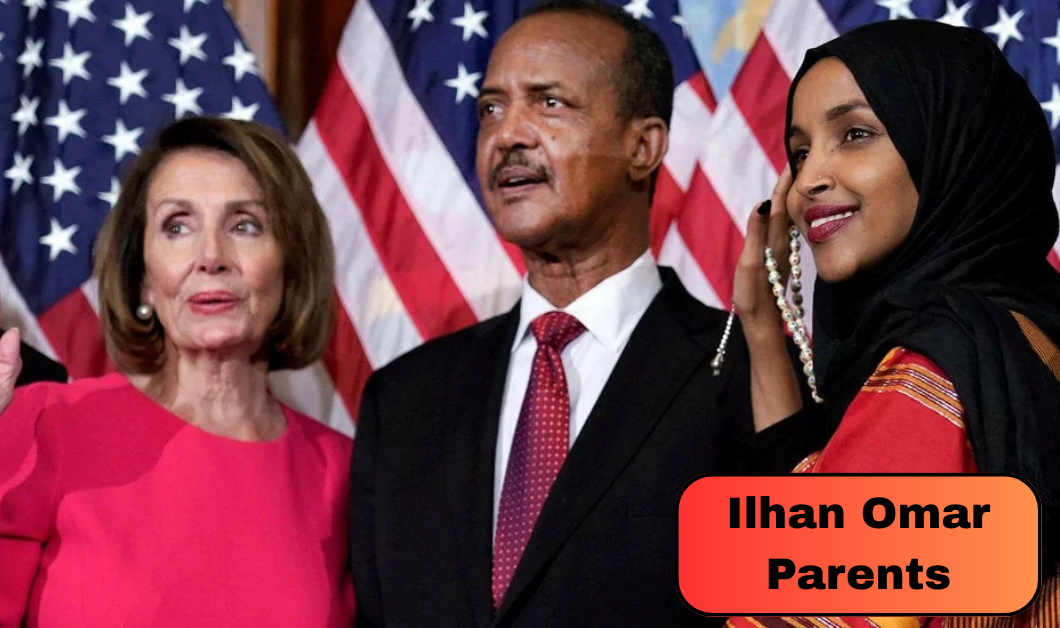
U.S. Representative Ilhan Omar was born to Nur Omar Mohamed and Fadhuma Abukar Haji Hussein in Mogadishu, Somalia, on October 4, 1982. Her childhood was shaped by the early loss of her mother, her father’s work in education and the military, and the family’s eventual escape from Somalia during the civil war. These experiences became an important part of her personal history before she entered American politics.
Omar’s mother died when she was just two years old, leaving her father and grandfather to play central roles in her upbringing. Her father later brought the family to the United States as refugees in 1995, where he worked to support his children while encouraging their education and interest in civic life. He died in June 2020 from complications related to COVID-19.
Who Are Ilhan Omar’s Parents?
Ilhan Omar’s parents were Nur Omar Mohamed and Fadhuma Abukar Haji Hussein. Both came from Somalia, where Omar spent her earliest years before political violence forced her family to leave the country.
Her father had a background in education and military service, while her mother came from a family with roots in Somalia’s Benadiri community.
Omar’s family valued education, public service and political awareness. Her father and grandfather encouraged conversations about government and social responsibilities, influences that Omar has frequently connected to her later political career.
The family experienced considerable hardship following her mother’s death. Omar was still a toddler when she lost her, meaning most of her childhood memories involve her father, grandfather and other relatives.
Despite these challenges, she grew up in an extended family that placed importance on learning and community involvement.
Ilhan Omar’s Father Nur Omar Mohamed
Nur Omar Mohamed was a Somali educator and former military officer who later became a refugee and settled in the United States.
Before Somalia’s civil war, he worked as a teacher trainer and served in the Somali National Army. Accounts of his military career describe him as a colonel who commanded a regiment during the Ogaden War, the conflict between Somalia and Ethiopia in the late 1970s.
His professional background reflected a combination of military service and educational responsibilities.
Following the outbreak of Somalia’s civil war in 1991, Mohamed and his family were forced to abandon their previous lives.
The conflict created widespread displacement, with many Somali families seeking safety in neighbouring countries.
Mohamed eventually took his children to Kenya, where they lived in a refugee camp for approximately four years.
The family later received permission to resettle in the United States, arriving in 1995.
Their move marked the beginning of a completely different chapter, as Mohamed adjusted to a new country while raising his children.
Ilhan Omar’s Mother Fadhuma Abukar Haji Hussein
Ilhan Omar’s mother, Fadhuma Abukar Haji Hussein, died when Omar was approximately two years old.
Because she was so young, Omar has few personal memories of her mother. Her early death meant that other family members became especially important in providing guidance and emotional support.
Fadhuma belonged to Somalia’s Benadiri community, a group historically associated with the country’s coastal cities and trading traditions.
Some biographical accounts also describe ancestral connections between her family and Yemen, although detailed public information about her relatives remains limited.
Unlike Omar’s father, whose career and later life in America have been documented more extensively, relatively little is publicly known about Fadhuma’s education, professional activities or the circumstances surrounding her death.
Omar has nevertheless acknowledged the importance of the extended family members who helped raise her following her mother’s passing.
Her childhood was shaped by relatives who worked in education and public service, creating an environment where discussions about society and government were common.
Ilhan Omar’s Childhood in Somalia and Kenya
Ilhan Omar spent her early childhood in Baidoa, a city in southern Somalia, before the country’s civil war forced her family to flee.
In 1991, Somalia descended into widespread conflict following the collapse of President Siad Barre’s government.
The violence disrupted ordinary life and forced thousands of families to leave their homes.
Omar was approximately eight years old when her family escaped the country.
They eventually reached the Dadaab refugee camp in Kenya, where they lived for about four years.
Life in the camp was considerably different from the family’s earlier circumstances in Somalia. They faced uncertainty about their future while waiting for an opportunity to resettle.
Throughout this period, Omar’s father remained responsible for supporting his children and maintaining their education.
In 1995, the family arrived in the United States through the refugee resettlement process.
They initially lived in Virginia before eventually establishing themselves in Minneapolis, Minnesota.
What Did Ilhan Omar’s Father Do in America?
After arriving in the United States, Nur Omar Mohamed had to rebuild his professional life.
Although he had previously worked in education and served in the Somali military, he took jobs outside those fields to support his family.
He worked as a taxi driver and later became an employee of the United States Postal Service.
His employment reflected the practical difficulties many refugee families encounter when establishing themselves in a new country.
Mohamed also remained involved in the Somali-American community in Minnesota.
He was remembered as someone who valued education, encouraged younger generations and maintained strong relationships with relatives and community members.
His daughter has frequently credited him with helping her understand the importance of civic participation.
Mohamed’s experiences as a refugee and immigrant also became part of the family history that Omar discussed during her political career.
How Did Ilhan Omar’s Parents Influence Her Political Career?
Ilhan Omar has often identified her father and grandfather as important influences on her political development.
Her grandfather, Abukar, reportedly held a senior position in Somalia’s National Marine Transport administration.
Other relatives also worked in government, education and public service.
Growing up in this environment exposed Omar to discussions about political institutions and social responsibilities.
After the family settled in Minnesota, her grandfather became interested in American politics.
Omar accompanied him to local political meetings and helped interpret conversations, giving her early exposure to the country’s democratic process.
She later became involved in community organising and political campaigns.
In 2016, Omar was elected to the Minnesota House of Representatives, becoming the first Somali-American legislator in the United States.
Two years later, she won election to the U.S. House of Representatives from Minnesota’s 5th Congressional District.
Her election made her one of the first two Muslim women to serve in Congress, alongside Rashida Tlaib.
When Did Ilhan Omar’s Father Die?
Nur Omar Mohamed died on June 15, 2020, at the age of 67 from complications related to COVID-19.
His death occurred during the early months of the coronavirus pandemic, when the United States was experiencing widespread illness and significant loss of life.
Omar publicly announced her father’s passing and expressed her grief.
In her statement, she said, “No words can describe what he meant to me and all who knew him.”
His death drew condolences from political colleagues, community leaders and members of Minnesota’s Somali-American community.
Mohamed was remembered for his dedication to his children, his commitment to education and his involvement in community life.
His passing represented a major personal loss for Omar, who had already experienced the death of her mother during early childhood.
Why Are Ilhan Omar’s Father’s Immigration Records in the News?
Nur Omar Mohamed’s name returned to public attention in October 2026 following reports of a federal investigation involving Ilhan Omar’s immigration history.
On October 12, federal agents searched Omar’s Washington, D.C., residence as part of an ongoing criminal investigation.
The Justice Department confirmed that Homeland Security Investigations had executed a judicially authorised search warrant.
Reports indicated that investigators were examining immigration documentation associated with Omar’s childhood, including records allegedly completed by her father when the family entered the United States.
Omar became a naturalised American citizen in 2000.
The precise allegations and the evidence underlying the investigation have not been fully disclosed publicly. No criminal charges had been announced against Omar as of October 13, 2026.
Omar denied wrongdoing and described the investigation as politically motivated. Democratic leaders also questioned the timing and circumstances of the search.
The investigation does not establish that Mohamed falsified immigration records or committed any offence. He died six years before the reported search, and the allegations concerning historical documents remain unresolved.
Ilhan Omar’s Family Background and Personal History
Ilhan Omar’s family history spans Somalia, Kenya and the United States.
Her mother, Fadhuma Abukar Haji Hussein, died during Omar’s earliest childhood years, while her father, Nur Omar Mohamed, raised her through displacement, refugee life and eventual resettlement in America.
Both parents remain important figures in her biography, although considerably more public information exists about her father’s life.
Mohamed’s background in education, military service and community involvement helped shape the environment in which Omar grew up.
His encouragement, alongside the influence of her grandfather, introduced her to political discussions long before she pursued public office.
Omar’s journey from a Somali refugee camp to the United States Congress remains closely connected to those family experiences.