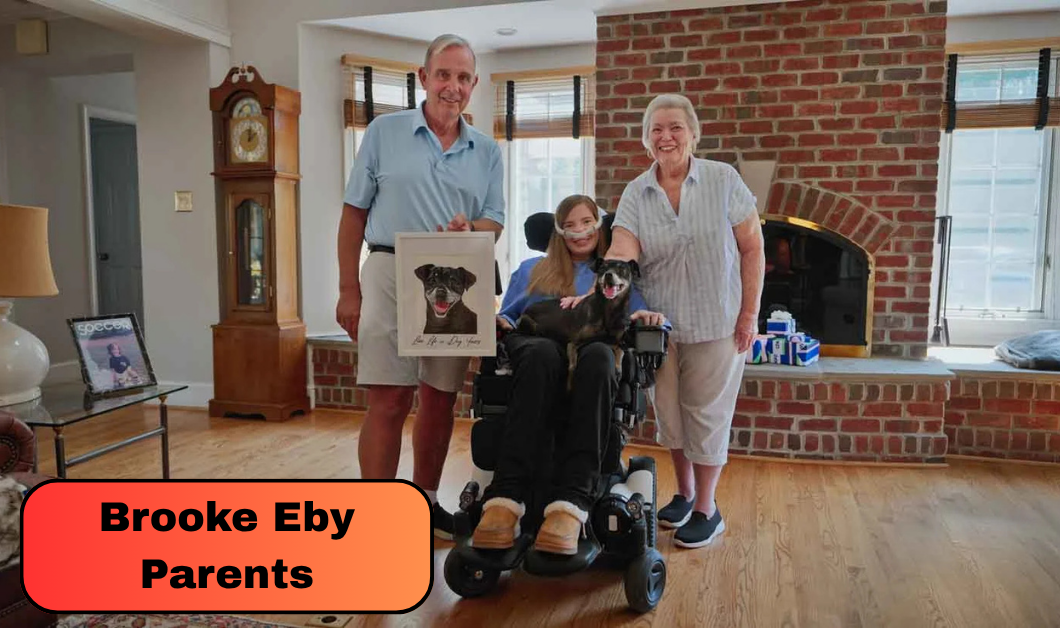
Brooke Eby became known to millions of people for something she never expected to become the center of her life. After being diagnosed with amyotrophic lateral sclerosis, better known as ALS, at age 33, she began documenting her experience online with honesty, humor and a willingness to talk about subjects many people find difficult.
Behind that public journey was a close family that supported her through the changing realities of the disease.
Brooke’s parents, Cliff Eby and Ginny Eby, became especially important as her condition progressed. They helped her navigate everyday challenges, adapted their home to meet her changing mobility needs and appeared alongside her during parts of her social media journey.
Her father, a retired engineer, brought a practical problem-solving approach to caregiving. Her mother provided another kind of support, helping with the emotional and organizational demands of daily life.
Together, Cliff and Ginny became an important part of Brooke’s story, even as she remained the person at the center of her own advocacy.
Who Are Brooke Eby’s Parents?
Brooke Eby’s parents are Clifford “Cliff” Eby and Ginny Eby.
The couple raised Brooke and her siblings in the Potomac, Maryland, area. Brooke also has a brother, Chris, and a sister, Sarah, who became part of the family’s efforts to support her and raise awareness about ALS. Lehigh University has described the Eby family as closely involved in Brooke’s advocacy and fundraising efforts.
Her family background is particularly notable because several members of the Eby family have connections to Lehigh University.
Cliff graduated from Lehigh in 1973, while Brooke graduated in 2010. Her brother Chris is also a Lehigh graduate.
For Brooke, family was never simply a background detail. As ALS changed what she could physically do, her parents became increasingly involved in the practical side of her everyday life.
Cliff Eby Is Brooke’s Father
Cliff Eby is Brooke’s father and a retired civil engineer.
His professional background became unexpectedly useful when Brooke’s ALS began affecting her mobility.
Lehigh University reported that Cliff spent more than four decades working in engineering and had also earned an MBA from George Washington University. His career taught him to approach complicated problems by looking for practical solutions, something that became particularly valuable when he began helping his daughter adapt to life with ALS.
Cliff described himself as a “frustrated inventor” when discussing the ways he tried to make Brooke’s daily routines easier.
The changes were not always permanent because ALS can progress rapidly. A solution that worked one day might need to be changed later.
That meant Cliff had to remain flexible.
Cliff Used Engineering Skills to Help Brooke
One of the clearest examples of Cliff’s role involved adapting the family’s home.
As Brooke’s mobility became more limited, ordinary activities could require much more planning. The bathroom became one of the areas where the family needed to find a safer and more practical solution.
Cliff and Brooke found a chair system that could glide along a track and help move her around the bathroom.
It was more than a technical adjustment. It represented the kind of everyday problem families dealing with ALS can face as physical abilities change.
Cliff’s engineering background gave him a natural way to approach those challenges.
Instead of viewing each new obstacle as something that could not be solved, he looked for another way to make it work.
Lehigh’s account of their experience describes Cliff’s approach as asking how they could make things easier as Brooke’s condition progressed.
Ginny Eby’s Role in the Family
Ginny Eby, Brooke’s mother, also played a major role during her daughter’s illness.
While Cliff’s engineering background often showed itself through physical adaptations and practical solutions, Ginny’s contribution involved the broader day-to-day demands of family caregiving.
That included helping organize medical needs, routines and the emotional side of navigating a progressive illness.
ALS can affect many aspects of daily life, meaning caregiving often requires constant adjustments.
For the Eby family, it was not just about helping Brooke physically. It was also about maintaining a sense of normality and making room for humor, family time and the work Brooke wanted to continue doing.
Ginny remained part of that support system alongside Cliff and Brooke’s siblings.
Brooke Lived With Her Parents During Her ALS Journey
As her condition progressed, Brooke lived with Cliff and Ginny.
That arrangement allowed her parents to be closely involved in her daily care while also giving the family the opportunity to adapt their home around her needs.
The situation also meant that Brooke’s parents became more visible in her online content.
Cliff in particular appeared in some of her videos, where his personality became part of the appeal of her posts.
Brooke’s social media content was not simply a record of medical appointments or physical challenges. She often used humor to make difficult subjects easier for other people to understand.
Her family became part of that approach.
Cliff Became Part of Brooke’s Social Media Story
Brooke became known for her candid and funny TikTok videos about living with ALS.
The ALS Association has described how she used humor to encourage people to ask questions about the disease and become more comfortable discussing it.
Her father eventually became something of an unexpected social media personality himself.
Lehigh’s alumni publication noted that Cliff accompanied Brooke on trips and speaking engagements and even developed his own presence through the videos they made together.
Their dynamic offered audiences something beyond the usual serious portrayal of illness.
Cliff’s personality could bring humor to a difficult situation, while Brooke remained open about the realities she was facing.
The Eby Family Supported Brooke’s ALS Advocacy
Brooke’s family did more than help her at home.
They also supported her efforts to raise awareness and money for ALS research.
Her advocacy grew considerably after her diagnosis. The ALS Association reported that she used her growing social media audience to educate people about ALS and encourage them to support research.
Lehigh University reported that the Eby family’s fundraising efforts eventually surpassed $1 million in 2025.
The family effort included Brooke’s siblings and their extended families as well.
That made ALS advocacy something that involved the entire Eby family rather than Brooke alone.
Brooke’s Brother and Sister Were Also Involved
Brooke was not an only child.
Her brother Chris Eby and sister Sarah Eby were also part of her family support network.
Lehigh reported that Chris, who is also a Lehigh graduate, and his family participated in efforts connected to Brooke’s ALS cause. His children also became involved in supporting their aunt’s advocacy.
That kind of involvement can be especially meaningful during a serious illness.
It meant Brooke had a wider family network around her, with different people contributing in different ways.
Cliff and Brooke Shared Special Moments
Their relationship was not only about caregiving.
Cliff also shared memories of Brooke from before her diagnosis.
One particularly emotional memory involved playing catch with his daughter when she was younger.
He recalled that when he came home from work, a glove and ball would sometimes be waiting in the backyard, and the two would go outside to throw.
Years later, Brooke was invited to throw the ceremonial first pitch at Baltimore Orioles and Washington Nationals games during ALS Awareness Night.
Cliff was there to watch.
For him, seeing his daughter on the field brought back those childhood memories and made the moment particularly meaningful.
Brooke’s Parents Helped Her Keep Her Sense of Humor
Brooke’s approach to ALS was unusual because she did not want her story to be defined only by sadness.
She openly acknowledged the seriousness of the disease while using comedy to make people more comfortable discussing it.
The ALS Association quoted Brooke explaining that humor helped people feel more comfortable asking questions.
Her parents became part of that atmosphere.
Rather than every family moment being presented as tragic, Brooke and Cliff could laugh together and find humor in ordinary situations.
That did not make the illness less serious.
Instead, it gave Brooke a way to maintain some control over how her story was told.
Her Parents Were There as Her Mobility Changed
Brooke’s ALS journey involved significant physical changes.
Lehigh University reported that she went from using a cane to a walker and eventually a wheelchair in less than a year.
Those changes naturally affected the entire household.
Her parents had to adapt along with her.
The family’s experience shows why caregiving for ALS is rarely a fixed routine. As physical abilities change, homes, schedules and methods of assistance may all need to change too.
Cliff’s engineering mindset was helpful in dealing with the physical side, while Ginny and the rest of the family helped provide the ongoing support needed around it.
Brooke Eby’s Parents Were Part of Her Legacy
Brooke used her platform to put a personal face on ALS.
Her story reached social media audiences, traditional media and the ALS community. She appeared on programs including the Today show and spoke to audiences about what it was like to live with the disease.
Her parents were often close by throughout that journey.
Cliff’s practical contributions and Ginny’s steady support became part of the larger family story.
For Brooke, having her parents beside her also meant that she did not have to navigate every challenge alone.
The Story of Cliff and Ginny Eby
Brooke Eby’s parents, Cliff and Ginny Eby, became central figures in the years following her ALS diagnosis.
Cliff brought his engineering experience to the practical challenges of caregiving, finding ways to adapt their home as Brooke’s mobility changed. Ginny helped with the emotional, medical and everyday demands that came with caring for a daughter living with a progressive illness.
Their children and extended family also joined the effort.
But perhaps the most striking part of their story is that they supported Brooke without taking the story away from her.
Brooke remained the advocate, comedian and storyteller. Her parents were there to help her keep going.
Through her videos, fundraising efforts and public appearances, she showed audiences what living with ALS could look like while still finding reasons to laugh.
And behind many of those moments was a family that kept showing up.
For Cliff and Ginny, supporting their daughter meant adapting again and again, learning alongside her and being present through both difficult days and meaningful milestones. Their role became an important part of Brooke’s story, not because they sought the spotlight, but because family was at the heart of the journey she chose to share with the world.