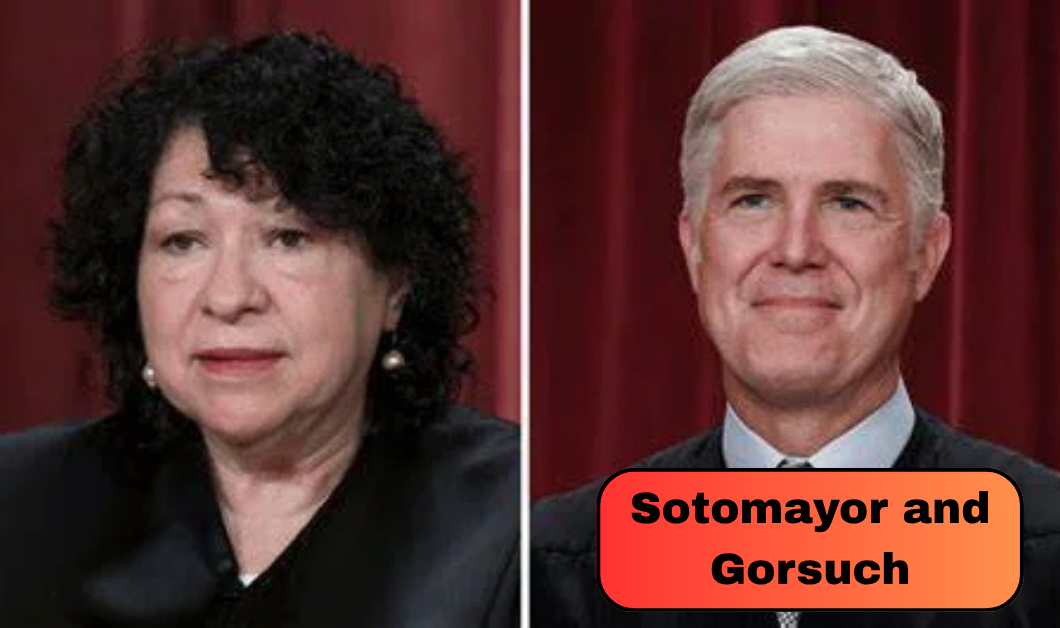
Two U.S. Supreme Court justices have raised serious concerns about the federal government’s handling of an immigration prosecution, warning that allowing repeated criminal charges for the same continuous conduct could undermine constitutional protections. Justice Sonia Sotomayor and Justice Neil Gorsuch joined together in an unusual statement questioning whether a man could legally be prosecuted twice for remaining in the United States after an earlier deportation.
The case, Herrera-Salazar v. United States, involves a defendant who was convicted of unlawfully being found in the country after deportation. Years later, authorities charged him again under the same federal immigration law, even though he had remained under government supervision following his first conviction.
Although the Supreme Court declined to hear the case, Sotomayor and Gorsuch used the October 13, 2026, order to highlight what they viewed as a troubling interpretation of the law. Their statement warned that the government’s approach could create a situation in which someone faces repeated punishment for a single continuing offense.
Why Did Sotomayor and Gorsuch Raise Concerns?
The disagreement centers on the Fifth Amendment’s Double Jeopardy Clause, which generally protects people from being prosecuted twice for the same criminal offense after a conviction or acquittal.
Sotomayor and Gorsuch questioned whether federal prosecutors had crossed that constitutional boundary by bringing a second immigration case against a man who had already been convicted for his unlawful presence.
The justices described the circumstances as unusual because the defendant had not simply returned to the United States after being deported a second time.
Instead, he remained in the country under conditions imposed by federal authorities.
That distinction became central to their concerns.
The government had required Herrera-Salazar to remain within a specific federal judicial district while he was on supervised release. Yet prosecutors later treated his continued presence in the United States as grounds for another criminal charge.
For the two justices, this raised an important question about whether the government could punish someone for conduct that its own supervision requirements effectively prevented him from ending.
What Happened in the Herrera-Salazar Immigration Case?
The legal dispute began in 2020 when Herrera-Salazar was indicted for being found in the United States after previously being deported.
The charge was brought under a federal immigration statute that makes certain forms of unlawful reentry into the country a criminal offense.
Herrera-Salazar pleaded guilty and received a prison sentence.
After serving his sentence, he remained subject to supervised release, a period during which federal authorities monitor an individual and impose specific conditions.
One of those conditions required him to stay within the Eastern District of Oklahoma.
In 2024, while still under federal supervision, Herrera-Salazar was stopped by police in Heavener, Oklahoma.
Authorities arrested him, and federal prosecutors brought another charge based on his presence in the United States following deportation.
A jury convicted him, and he received additional terms of imprisonment and supervised release.
The unusual aspect of the case was that both prosecutions arose from his continued presence in the country following the same earlier removal and reentry.
There was no separate departure and unlawful return between the two prosecutions identified in the justices’ statement.
Herrera-Salazar was eventually deported after the second conviction.
What Is the Double Jeopardy Clause?
The Double Jeopardy Clause is part of the Fifth Amendment to the United States Constitution.
It protects individuals against certain forms of repeated criminal prosecution and punishment for the same offense.
The principle is intended to prevent prosecutors from repeatedly bringing charges over conduct that has already resulted in a final criminal judgment.
However, determining whether two prosecutions involve the same offense can become complicated.
Some crimes involve separate actions that occur at different times. Others involve conduct that continues over an extended period.
For example, when a criminal offense is legally treated as continuous, prosecutors generally cannot avoid double jeopardy restrictions merely by dividing the same uninterrupted conduct into different periods.
That distinction was central to the concerns raised by Sotomayor and Gorsuch.
They questioned whether the government had improperly divided Herrera-Salazar’s ongoing presence in the United States into separate criminal offenses.
Their statement suggested that allowing such prosecutions could weaken constitutional protections by giving prosecutors excessive freedom to determine when one offense ends and another begins.
Why Did the Supreme Court Decline to Hear the Case?
Despite their constitutional concerns, Sotomayor and Gorsuch did not dissent from the Supreme Court’s decision to deny review.
The justices pointed to Herrera-Salazar’s deportation as a significant factor in their decision not to pursue the case further.
Because he had already been removed from the United States, the circumstances made the case a less suitable vehicle for resolving the broader constitutional question.
However, the denial of review did not mean that the two justices agreed with the government’s interpretation of the law.
They issued a separate statement explaining why the prosecution raised serious legal concerns.
This distinction matters because the Supreme Court’s refusal to hear a case does not necessarily amount to approval of the lower court’s reasoning.
The justices’ statement was also not a binding Supreme Court ruling establishing a new nationwide legal standard.
Instead, it served as a warning to lower courts about similar prosecutions that might arise in the future.
How Did the Federal Appeals Court Interpret the Law?
Before reaching the Supreme Court, Herrera-Salazar challenged his second conviction before the U.S. Court of Appeals for the 10th Circuit.
The appeals court rejected his double jeopardy argument.
Its interpretation focused on the federal unlawful reentry statute, 8 U.S.C. Section 1326.
Under the appeals court’s reasoning, the law did not require prosecutors to establish a separate unlawful reentry for every violation involving someone being found in the United States.
That interpretation allowed the second conviction to stand despite the absence of a new border crossing.
Sotomayor and Gorsuch expressed concern about the consequences of that reasoning.
If a single unlawful reentry could support repeated prosecutions whenever authorities encountered the same person, the number of possible criminal charges might become effectively unlimited.
The justices suggested that this outcome would conflict with the purpose of the Double Jeopardy Clause.
Their analysis focused on whether the defendant’s continued presence should be treated as one ongoing offense rather than multiple independent crimes.
Could Someone Face Repeated Charges for Remaining in the United States?
One of the most striking parts of the justices’ statement involved the potential consequences of allowing repeated prosecutions for continuous unlawful presence.
Sotomayor and Gorsuch warned that the government’s interpretation could theoretically permit prosecutors to bring new charges for different periods of the same uninterrupted conduct.
Under such reasoning, a person might face separate charges based on being found in the country during different months or even weeks.
The justices also pointed to an especially troubling possibility.
If continued presence alone could justify repeated charges, the government might theoretically prosecute someone for remaining in the United States while serving a prison sentence imposed by that same government.
The example illustrated what the justices viewed as a fundamental problem with the prosecution’s legal theory.
A person serving a federal prison sentence cannot independently decide to leave the country.
Similarly, someone under supervised release may face legal restrictions on travel and movement.
The justices questioned whether prosecutors could fairly treat compliance with those restrictions as the basis for another criminal offense.
Their concern was not simply about immigration enforcement. It involved the broader constitutional limits on how the government defines and prosecutes continuing criminal conduct.
Why Did the Justices Describe the Situation as a Hobson’s Choice?
Sotomayor and Gorsuch also highlighted the difficult position Herrera-Salazar faced after his first conviction.
He was required to remain within the Eastern District of Oklahoma as part of his supervised release conditions.
Leaving the district without authorization could violate those conditions.
At the same time, remaining in the United States exposed him to another prosecution under the government’s interpretation of federal immigration law.
This created what the justices characterized as a Hobson’s choice, a situation in which the available options offer no meaningful lawful alternative.
If Herrera-Salazar stayed where authorities instructed him to remain, he risked another immigration prosecution.
If he attempted to leave without permission, he could violate the terms of his supervised release.
The justices believed this conflict made the constitutional concerns particularly serious.
Their statement emphasized that the government should not be able to create conditions that prevent someone from ending an alleged offense and then repeatedly punish that person for the same continuing conduct.
What Could the Warning Mean for Future Immigration Cases?
The statement from Sotomayor and Gorsuch does not immediately change federal immigration law or overturn Herrera-Salazar’s conviction.
However, it could influence how judges and defense attorneys approach similar cases involving unlawful reentry and repeated prosecutions.
Lower courts may need to consider whether a defendant’s presence in the United States represents a new criminal offense or simply the continuation of conduct already addressed by an earlier conviction.
The issue could become especially important when individuals remain in the country because of imprisonment, supervised release, or other government-imposed restrictions.
The unusual agreement between Sotomayor and Gorsuch also makes the statement noteworthy.
The two justices often approach constitutional questions from different judicial perspectives, but both expressed concern about the government’s ability to repeatedly prosecute the same continuing conduct.
Their shared position suggests that the issue extends beyond conventional ideological disagreements about immigration policy.
For now, the Supreme Court has left the lower court’s judgment undisturbed. But the separate statement makes clear that at least two justices believe the constitutional questions deserve serious attention.
If another case presents similar circumstances, courts may have to examine more closely where one immigration offense ends and whether a second prosecution can legally begin.